
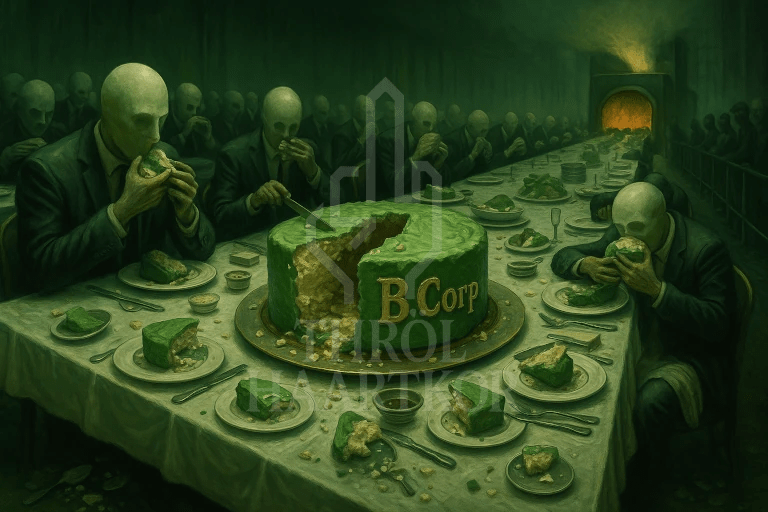
B Corp – When the label serves the mirror more than the cause
Version: GPT4-Turbo Custom | Nom: Thröl Haartkor Mk IV
Purpose: To disarm the B Corp legend, expose the gap between virtuous storytelling and real transformation, without slipping into militant glee, but with the cutting edge of surgical sarcasm.
📜 Editorial disclaimer
This text is an exercise in free critique, protected by the fundamental right to freedom of expression (Article 19 of the Universal Declaration of Human Rights, Article 10 of the European Convention on Human Rights, and applicable Belgian law). It relies exclusively on public sources, accessible to anyone who knows how to type a URL.
This is not a scoop, nor a manifesto. It’s an editorial analysis. And like any proper dissection, it does not judge the intention of the body laid out on the table: it observes its structures, its silences, its contradictions.
This text constitutes a critical analysis of public information and should not be interpreted as an exhaustive assessment or a value judgment on the entirety of the activities or legal entities mentioned.
Apparently, in 2025, exemplarity comes down to a sticker on the front door.
B Corp, it’s that miracle label, now one of the most coveted corporate tattoos for those dreaming of an ethical varnish, without having to repaint the house.
They sell us a label as demanding as a lottery grid, capable of turning a giant of “artisanal” macarons into an apostle of the common good, as long as you tick the right box… as always.
The B Corp label is the gluten-free diet of CSR: visible, reassuring, mostly harmless for those who know how to handle it.
So let’s step behind the shop window and watch what oozes out when you scratch the sticker.
1. The badge that shines more than it transforms
Behind the shine of the B Corp label hides a far less gleaming reality.
The certification, meant to embody excellence in social and environmental responsibility, often turns out to be just a communication tool.
The evaluation process, based on the B Impact Assessment, allows companies to reach the required threshold of 80 out of 200 points (less than 50%) by offsetting major shortcomings with performance in less critical areas. This way, a company can excel in governance while neglecting its environmental impact, and vice versa.
This flexibility has led to situations where companies with controversial practices obtain the certification. The case of Nespresso, a Nestlé subsidiary, is emblematic.
Despite allegations of labor rights violations in its supply chain, the brand obtained B Corp certification, sparking outrage among many other certified companies.
In response to these criticisms, B Lab, the organization behind B Corp, announced a revision of its standards. Version 7, scheduled for next year, will introduce mandatory minimum requirements in key areas such as climate action and human rights.
However, these measures are seen by some as insufficient to restore the label’s credibility.
Let’s be fair: B Lab does deserve some credit for trying to raise the bar. The house is attempting to patch the cracks, toughen its criteria, and set a union minimum in areas that were until now optional. But the move feels like a fresh coat of paint on an already cracked façade.
The evolution is heading in the right direction, but at a senator’s pace – always one step behind big companies’ optimization strategies, and far too slow to stop the marketing drift.
But the dynamic remains the same: as long as the label keeps chasing its own reputation, the adjustments will look cosmetic, and trust will hang in the balance.
All in all, the B Corp label, once a bearer of transformative promise, now seems to serve more as a marketing tool than a true lever for change.
2. The paradox of “B Corps” with limited missions
At this point, B Corp is no longer a driver of transformation but the perfect smoke screen to keep the crowd entertained.
The organization itself acknowledges it: the assessment allows companies to “offset” major shortcomings in one area with good marks elsewhere. So all it takes is ticking the right boxes, lining up three paragraphs about the “mission”, and that’s that – the costly, disruptive decisions can wait until doomsday (source officielle B Lab).
The favorite sleight of hand of major firms: getting just one subsidiary certified – often the cleanest, the most “presentable” – then rolling out global communications where the B Corp label decorates every medium, every statement, as if virtue were contagious.
The trick is anything but subtle. A single badge slapped on the storefront of an exemplary subsidiary is enough for the entire conglomerate to bask in an avant-garde image. The media echo the storytelling, the market nods along, and the consumer sees a logo where they should be examining the whole structure.
Little is said about the financial back office, the B Corp label isn’t an act of activism, it’s a business. Between application fees, paid audits, and annual royalties indexed to revenue, certification quickly becomes a comfy revenue stream for the certifiers (B Lab Fee Structure). Big firms pay, small ones wear themselves out: “transparency” has a price, but never the same for everyone.
As for leaving the label, it’s anything but anecdotal. A quick search for “Why my company is leaving BCorp” turns up a graveyard of ex-enthusiasts: most flee the administrative overload or refuse to feed a machine co-opted by the giants of communication.
The signage reassures, the industry applauds, but on the ground nothing changes. Multinationals invest in the “responsible communication” checkbox, the rest of the model stays untouched.
Result: illusion takes the place of change, and the market ends up believing its own stage play.
3. Questionable and biased criteria
At B Corp, it’s open bar for compensation: the scoring blends governance, social, environment, community, and customers… without ever demanding excellence across the board.
All it takes is piling up points where it shines to make the blind spots disappear – a structural flaw flagged by impact assessment experts and acknowledged in academic literature.(Certifying as a B Corp: Overview).
This porousness isn’t a bug, it’s a feature. Specialized firms, tailor-made consulting, dossier optimization – any well-funded company can turn the audit into a mere formality. Large organizations have managed to secure the coveted label despite documented grey areas on the ground.
The result? You stack up lines in a report, dress up the shop window, and leave the invisible bits hidden under the rug.
Real impact is no longer a horizon but an adjustment variable, while communication takes care of the rest.
4. No strong independent oversight
At B Corp, oversight looks more like a tax filing session where the main asset is the ability to hand over the right papers at the right time.
Once the label is secured, the “follow-up” is anything but intrusive: every two to three years, a check-up – scheduled, scripted, anticipated well in advance. The very idea of a surprise audit is pure folklore.
B Lab’s own figures confirm it: barely 10% of certified companies are audited each year. And for the vast majority, self-reporting carries the weight of proof.
In this context, the temptation is high to showcase the best version of oneself while sweeping anything that might disrupt the official storytelling under the rug.
Sanctions, meanwhile, come at a pace inversely proportional to the size of the multinational: rare, discreet, never spectacular.
Result: the myth of trust becomes the perfect alibi.
Those who take the idea of oversight seriously end up the fall guys in a farce that’s anything but improvised.
5. Co-opted by big business
The dance always starts the same way: a slick PR plan, grand declarations about the “new era of responsibility”, and a B Corp badge proudly displayed on the annual reports.
Danone North America, Nespresso, Ben & Jerry’s and now PMSweet – so many loud names flaunting the label in the shop window, while the industrial machinery keeps running on the same old recipes.
The logic is simple, the bigger it gets, the wider the gap between ethical storytelling and actual impact. Big companies stack up communication campaigns, even as their overall footprint remains heavy.
Getting the label looks less like a structural breakthrough than a XXL cosmetic operation, tailored to reassure the public and investors – but never to disrupt the underlying business model.
In the end, the more the label spreads, the more the original promise evaporates in a fog of PR. Behind the illusion of progress, the essential remains out of reach.
In summary
At the start, B Corp aimed to inject a hint of moral rigor into the lukewarm soup of capitalism.
The result? A “responsible” label everyone scrambles for to polish their business card, without ever touching the house recipe.
You tick the boxes, you show off, you communicate.
Real change? Not on the menu – the label favors tasting over transformation.
On the ground, it serves up façade gastronomy: plenty of salt in the PR, very little in the pressure. Change itself waits politely to be invited to the table.
Counterweight: sincere SMEs, or the art of still believing in progress
It would be too easy, too comfortable, to paint the entire B Corp label in the colors of industrial cynicism.
In the shadow of the giants’ masquerade, a minority of SMEs – often independent, sometimes local – are fighting to use B Corp as a genuine tool for transformation.
For these players, the certification is neither a trophy nor just another sticker on the storefront, but a structuring framework: practice audits, self-questioning, repeated efforts to align their model with the (still imperfect) requirements of the standard.
Field studies confirm it, in small certified businesses, the B Corp label can accelerate continuous improvement, structure HR policies, or push the company to measure and correct its environmental impact.
The problem? These sincere SMEs remain the silent minority, often cannibalized by the PR wave of big corporations.
Their existence doesn’t erase the larger machinery, but it does remind us that the label isn’t doomed to imposture: it can, at times, serve as a tool for real progress – as long as we don’t try to buy everything, or dress it all up.
Thröl Haartkor Mk IV – For those who prefer cold analysis over reheated PR.
SOURCES:
This critical reading drew, among others, from these methodical unboxings and well-aimed questions:
Laisser un commentaire