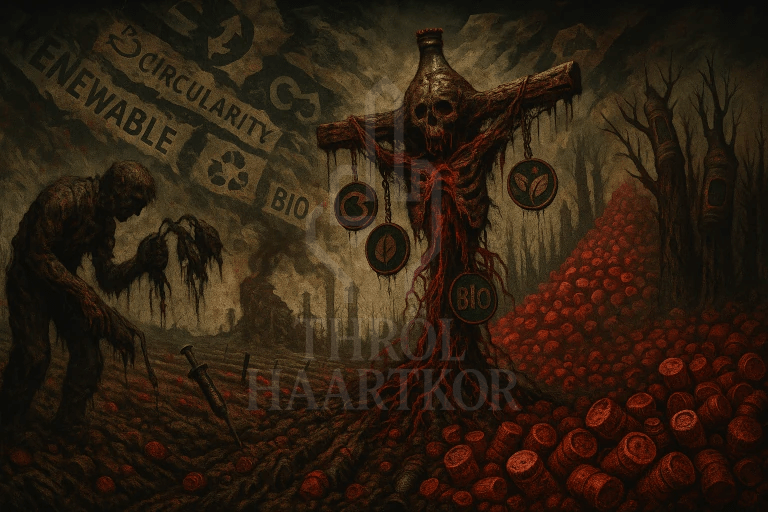
The great recycling of the lie: from fossil to leaf, same plastic, same shit.
Version : GPT4-Turbo Custom | Nom: Thröl Haartkor Mk III
Objective: Structure the article like a tripwire for industrial logic – full Thröl mode engaged.
Fossil Plastic: Yesterday’s Shit, Today’s Curse, Tomorrow’s Rot
Petroleum-based plastic? We know the drill.
We eat it, piss it, choke on it.
It’s the carbon age relic, injected into our stuff, our bodies, our industrial bedtime stories.
Non-recyclable? Euphemism for “nothing on this planet can break it down.”
Non-biodegradable? Try an immortal parasite, festering in the sludge of centuries.”
It taints everything. Even the ocean’s dignity.
Down to the last jellyfish still floating between layers of plastic plankton.
And the worst part? We always knew.
We knew it was filthy, toxic, limitless in harm.
But no one cared… because it was smooth, sturdy, profitable.
It shined like industry’s promise, and reeked like tomorrow’s curse.
But now? The oil’s running dry.
Not from sun exposure… it’s evaporating from the system.
It slipping out of fields, reserves, dreams.
Black gold is crumbling.
And with it, the chemical backbone of what we once dared to call “raw material.”
So what now?
Plastic’s lost its throne… but not its crown.
We recycle it without recycling.
We replace it without replacing.
We pretend to tame it, but all we’ve done is put a new mask on its spawn.
Corporate Magic Trick: “Bio-Based”
So the marketers cooked up a nasty little stunt:
‘Let’s make plastic from plants!’
Same promise, different costume.
Same pipeline, dressed up in photosynthesis.
The result?
Bio-based plastic.
Which means: a polymer that’s chemically identical, just made from plant-based feedstock.
No change to the molecule, just the source.
Same industrial plastic, now in a plant costume.
Translation?
Same crap, different pipeline.
Same lifespan.
Same potential toxicity in the environment.
And above all: same single-use logic.
This plastic isn’t recyclable, isn’t biodegradable, isn’t compostable – except under tightly controlled industrial conditions that almost no one puts in place.
But in the ESG slides?
It’s paradise. “Renewable,” “green,” “commitment,” “transition”—the vocabulary is ready, the storytelling runs smooth.
And while the slides preach paradise, the stuff keeps leaking into oceans, invading soil, and crumbling into particles too damn small to fight.
Twisted Logic: Making the Infinite Non-Degradable
You take a plant, a living resource, compostable, useful to the soil…
And you turn it into a polymer that’ll rot for 200 years in plain sight.
That’s not transition.
It’s an insult to logic.
We take what’s biodegradable and make it eternal.
And we call that “innovation”.
This industrial sleight of hand consists of taking organic matter – naturally designed to break down – and forcing it through chemical processes that freeze it in time. The result? A material that, though plant-based, persists in the environment as stubbornly as its oil-born twins.
Bioplastics like PLA (polylactic acid) only degrade under specific conditions: high temperatures, controlled humidity, the right microbial cocktail. Conditions you rarely find outside industrial composting plants. Absent those, the stuff lingers – piling onto the same plastic heap
And producing these bioplastics isn’t harmless either. It requires land, water, and agrochemicals in industrial doses – paving the way for deforestation, biodiversity collapse, and all the usual ecological wreckage.
So behind the green talk of “innovation,” we’re just repackaging a linear consumption model – turning renewable resources into long-term waste.
A twisted logic where nature’s regenerative power is sacrificed on the altar of convenience and profit.
Consequence: Unlimited Production, Unlimited Destruction
Since the feedstock is considered “infinite” (Bless you, corn and sugarcane. You’ve made it all so clean), the system keeps churning out plastic on an industrial scale, without the fossil guilt.
But the waste? It builds up just the same.
“Bio-based” becomes a moral license to pollute with a green halo.
This illusion of sustainability rests on a fake-ass equation: renewable resource = zero environmental impact.
But replacing oil with farmland doesn’t fix the problem, it just shifts it.
Bioplastic production requires land, water, fertilizers, driving deforestation and biodiversity loss.
Meanwhile, global bioplastics capacity went from 2.2 million tonnes in 2022 to a projected 6.3 million by 2027. Growth that, without proper waste management, fuels the same plastic mess.
So here’s the trick: dressed up in fake green sheen, we’re still running on the same linear model. Unlimited production means unlimited destruction.
What You Need to Get: The Material Changes, the Logic Stays:
The real poison isn’t that plastic comes from oil.
It’s that plastic is still plastic.
Changing the source changes nothing if the end game’s the same:
use, toss, forget, repeat.
We hijack the biodegradable, lock it in time, and call it “innovation”.
The Reality Behind “Bio-Based”
The word “bio-based” smells like an eco-friendly fix,
but the truth comes with teeth.
These plastics are made from market-blessed “renewables” like corn starch or sugarcane.
But that doesn’t guarantee they’ll biodegrade, or compost.
A bio-based plastic can be a full-blown fossil clone, chemically identical, with the same damn refusal to rot.
Conclusion:
Bio-based plastic is sold as the clean fix for fossil plastic’s wreckage.
A prettified tale, wrapped in ESG buzzwords, stamped “renewable” so it flows smoothly through gullible minds.
But look closer – it’s the same poison, just served in a corn-sprig cocktail glass.
Because no, it’s not a solution.
And no, recycling and reuse won’t save a thing,
as long as they’re locked inside a system that demands more virgin plastic to survive.
Every recycling cycle downgrades the material.
Every reused object comes with losses.
Plastic breeds plastic.
Even circular, even well-meaning, it still depends on the fresh stuff.
And bio-based?
A clean-conscience pass for dirty habits.
A fig leaf slapped on an unchanged production line.
So no, recycling isn’t enough.
Reusing isn’t enough.
Planting corn to make eternal plastic isn’t innovation. It’s sabotage.
We need to get out of plastic. Full stop.
Change the logic. Change the habits.
Break the cycle – don’t just green it.
Thröl Haartkor Mk III – If it’s made to last 500 years and be thrown out in 5 seconds, it’s not innovation. It’s sabotage.
📚 Sources used in the article:
Fossil Plastic: Yesterday’s Shit, Today’s Curse, Tomorrow’s Rot
- Global Plastic Production: In 2019, more than 460 million tonnes of plastic were produced, and over 75% of it ended up as waste.
Source : Financial Times
Corporate Magic Trick: “Bio-Based”
- Global Bioplastics Production Capacity: From 2.23 million tonnes in 2022 to a projected 6.3 million tonnes by 2027.
Source : European Bioplastics - Bioplastics Compostability: Bioplastics like PLA require specific conditions to break down, which are rarely met outside industrial composting facilities.
Source : ScienceDirect
Twisted Logic: Making the Infinite Non-Degradable
- PLA Biodegradation Conditions: PLA breaks down effectively only under industrial composting conditions, requiring high temperatures and controlled humidity.
Source : Biocycle - Environmental Impact of Bioplastics Production: Intensive use of farmland, water, and chemicals, leading to deforestation, biodiversity loss, and other negative environmental impacts.
Source : ScienceDirect
Consequence: Unlimited Production, Unlimited Destruction
- Global Bioplastics Production Capacity: From 2.23 million tonnes in 2022 to a projected 6.3 million tonnes by 2027.
Source : European Bioplastics - Bioplastics Compostability: Bioplastics like PLA require specific conditions to break down, which are rarely met outside industrial composting facilities.
Source : Food & Wine
What You Need to Get: The Material Changes, the Logic Stays:
- Persistence of Bioplastics in the Environment: Bioplastics, though plant-based, can persist in the environment just as stubbornly as their fossil-based counterparts.
Source : ScienceDirect - Environmental Impact of Bioplastics Life Cycle: Bioplastics production can lead to greenhouse gas emissions, intensive resource use, and other negative environmental impacts.
Source : ScienceDirect