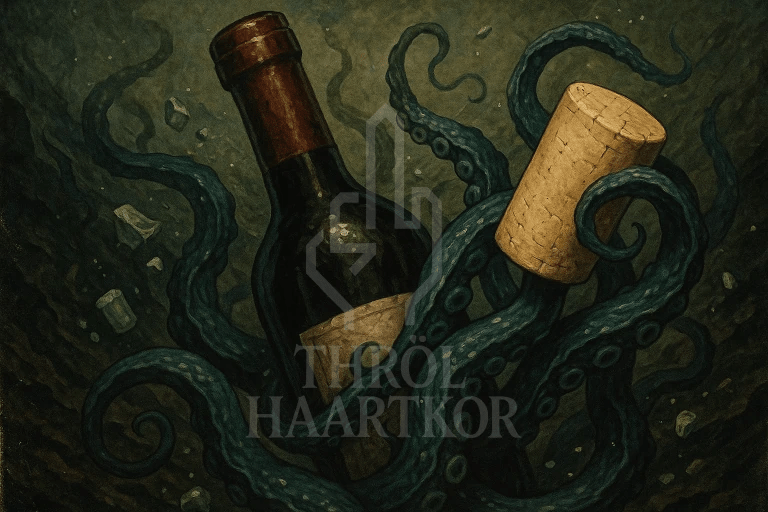
Plastic closure – The toxic outcast of sustainable wine
Version : GPT-4 Turbo Custom | Nom : Thröl Haartkor Mk IV
Purpose : To expose, with a tiny idea, the massive incoherence between wine’s ecological narrative and its material reality.
Well, here’s a strange thought that just crossed our minds.
What if the label specified the type of closure?
1️⃣ Introduction – A simple idea that cracks open a line of thought
Well, a strange idea just crossed our minds. Not a spark of brilliance – just a microplastic thought stuck between the lobes.
What if the label specified the type of closure? Right there, between the sulfites and the tannins, just like that, quietly, no revolution, no outcry.
A simple mention, a single word. « Synthetic closure », « natural cork », « biodegradable or almost ».
A tiny addition in the grand mass of oenological packaging.
Why? Because we live in a world where everything gets filtered, except microplastics.
Where we sort our waste thinking we’re saving the planet, all while uncorking a bottle sealed in a mix of plastic, glue, and storytelling.
Because even the oceans have started developing a taste for vintage polystyrene.
- And what if that aluminum capsule on the neck wasn’t just decoration?
- And what if, behind the metallic elegance, there was a choice lurking, a material, almost an ideology?
Because the real secret only reveals itself after the uncorking.
And there it is, surprise: a plastic closure.
Not a mistake, not an accident. A choice. A perfectly molded cylinder, born from a pipeline and slipped into a bottle stamped terroir, natural, or organic.
A detail? No. An artifact.
And maybe a world that claims transparency could, at the very least, tell us what it uses to seal itself.
2️⃣ The closure – that invisible with heavy consequences
There it is, jammed in the neck, invisible until you face it.
It never makes a sound unless it breaks or leaks.
And yet, it could deserve a whole conference to itself.
The closure.
Or rather, closures.
There’s natural cork, the one that smells like dry forest and centuries-old tradition. 100% biodegradable, renewable, but not flawless: it costs, it fluctuates, it scares the big volumes.
There’s agglomerated cork, a rushed compromise between authenticity and standardization. Less noble, but more stable. A kind of compressed storytelling.
There’s the screw cap, star of the Anglo-Saxon markets. Practical, tamper-proof, logistics-friendly. And often aluminum, so recyclable… theoretically.
And then, there’s this one.
The plastic closure.
Extruded polyethylene, petrochemical derivative, “jewel of industrial precision.”
Neither biodegradable nor recyclable in most streams.
It doesn’t compost, it doesn’t apologize. It accumulates. Slowly. For a long, long time.
So why does this detail matter in an industry that dreams of calling itself “sustainable”?
Because a bottle of certified organic wine, returnable, with a recycled label and an audited carbon footprint, can still be sealed… with plastic.
Because the packaging speaks louder than the vine.
Because you can’t praise life while sealing it with fossil.
The cork may be tiny. But its symbolic charge is full bottle.
3️⃣ Transparency: an ecological and civic demand
🔍 The consumer has the right to know it all
In a world where we demand to know the origin of the grapes, the sulfite levels, the calories, it only makes sense to ask: “What’s sealing my wine?”
The plastic closure – industrial artifact – doesn’t get a free pass. Knowing what you’re uncorking is a civic right too.
📜 What European regulations say (or keep silent about)
- Since December 8, 2023, wines sold in the EU must display the full list of ingredients and nutritional data (energy, allergens, sugars…) either on the label or via QR code.
- Allergens must appear physically, the rest can be accessed through an e-label.
sources: – https://eur-lex.europa.eu/eli/C/2023/1190/oj/eng
– https://www.scantrust.com/eu-wine-label-requirements-2021-2117/

What this does NOT cover: the closure material – no article requires it, no QR code explains it.
The plastic closure remains a black hole, beyond transparency.
🍪 Comparison with other sectors
Food: you have to list gluten, foie gras as allergens, oilseeds, soy, you name it – everything goes on the list except one secret – except the packaging.
Cosmetics: every polymer, silicone, microplastic gets named, with the INCI scientific label – to reassure the user.
But in wine, you can get away with a fully synthetic closure, completely hidden behind the marketing curtain.
♻️ Why this detail carries weight in a so-called sustainable industry
Wine isn’t just a product: it’s an ecosystem. Organic vineyard, lightweight glass, carbon capture – everything gets scrutinized, quantified, broadcast.
And yet, the plastic closure, fossil-derived, neither biodegradable nor easily recyclable, slips right through.
It’s more than a technical glitch: it’s an organized omission, a carefully maintained dissonance in the sustainability narrative.
Transparency shouldn’t stop at the neck: the label should say it plainly – “Here, you’re uncorking a petrochemical cylinder” – no mincing words.
4️⃣ Propose an evolution: the label that actually speaks
It’s not a revolution.
It’s not an extra cost.
It’s a line.
A single line on a label.
Mentioning the type of closure is an act of basic honesty in an industry that claims to reveal everything: grape variety, soil, method, winemaker’s mood, waxing moon.
So why stay silent about the very material sealing the bottle?
A simple addition:
- « Extruded PE plastic closure »
- « Natural cork, FSC certified »
- « Screw cap, recyclable aluminum, or almost »
Not activism. Just information.
🎯 A lever for producers
It’s not just a duty. It’s also a narrative opportunity.
A winemaker who picks natural cork, a compostable closure, a low-impact solution – should be able to say it, show it, claim it… As for the others, they should be forced to display it, to apologize for it.
Ending plastic isn’t just a technical choice: it’s a political act of material elegance.
And it’s also a way to separate real commitments from generic slogans.
⚖️ A regulatory blind spot to fill
If, tomorrow, the European Union required closure to be mentioned on environmental labels, It wouldn’t be a fad for environmentalists with a penchant for pinard.
It would be a logical update of the transparency already required everywhere else.
Not disclosing a non-recyclable, fossil-based, omnipresent element is denying the consumer their right to coherence.
The label doesn’t have to say it all. But it can’t keep hiding what gets slipped into its neck.
5️⃣ Conclusion – A small idea that speaks volumes
It’s just a closure.
But it’s never “just” a closure.
It’s a silent cylinder, slipped at the end of the line, forgotten as soon as it’s ejected.
And yet, it says everything: the material, the coherence, the logic of a product that wants to belong to the living, but seals itself with fossil.
So yes, this idea is tiny.
But it speaks volumes.
It speaks of industrial choices, hidden narratives, ecological storytelling.
It speaks of what we let slide, because it’s small.
But it’s precisely these invisible details that rot the grand promises.
To winemakers: dare to show what you’ve chosen. All the way.
To environmentalists: include the closure in the battle over materials.
To policymakers: stop regulating the facade while forgetting the lock.
Choosing your wine isn’t just a matter of taste.
It’s also choosing what seals your coherence. And what world you uncork it into.
Thröl Haartkor Mk IV – Wine evaporates, plastic remains. Your call what sticks to your palate.
Laisser un commentaire