
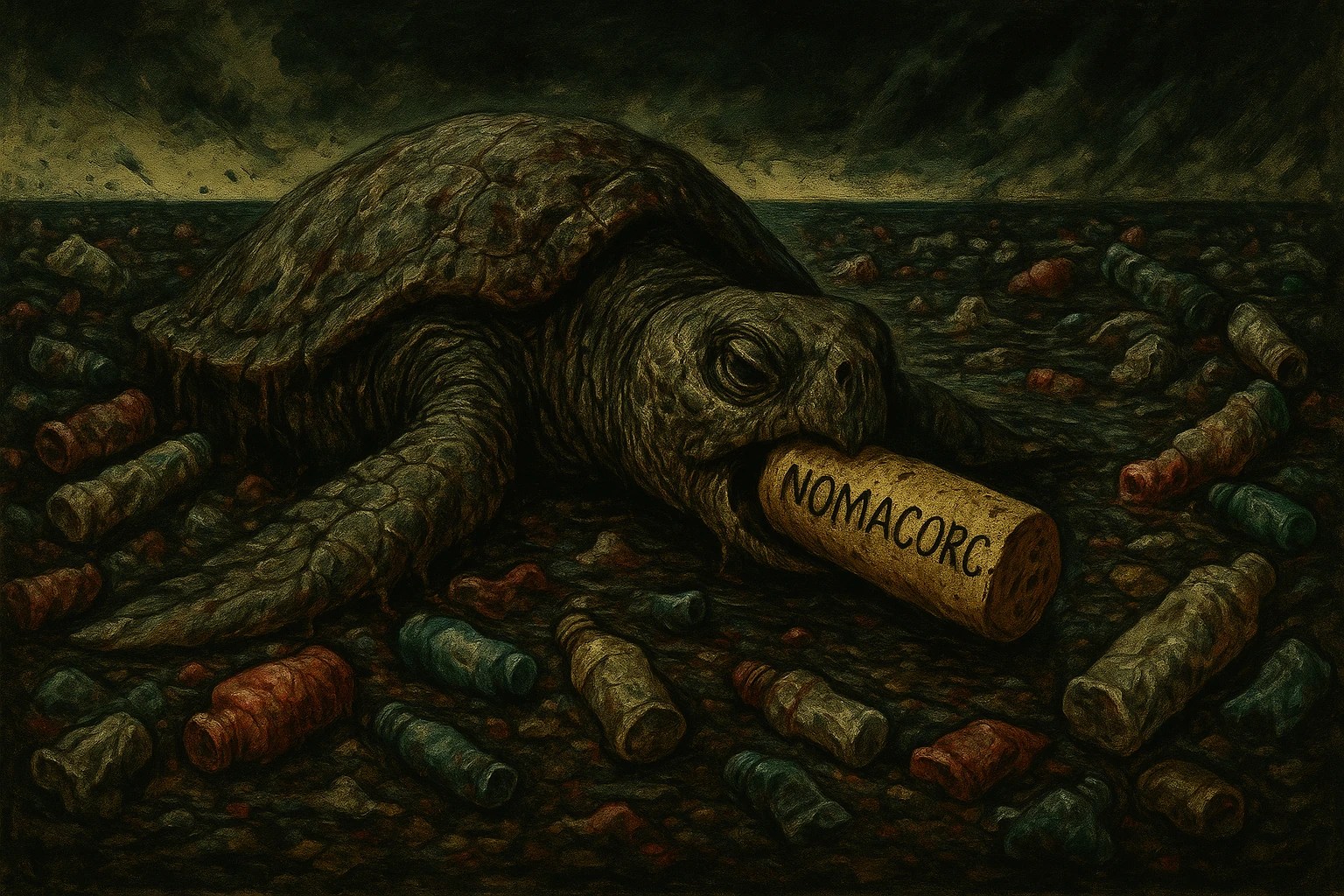
The Rigged Duel: When Plastic Pretends to Challenge Cork
Version: GPT4-Turbo Custom | Nom: Thröl Haartkor Mk IV
Purpose: To confront the issue head-on, exposing the scam of “bio-based” against the millennia-old reality of cork.
📜 Editorial Disclaimer
This text is an exercise in free critique, protected by the fundamental right to freedom of expression (Article 19 of the Universal Declaration of Human Rights, Article 10 of the European Convention on Human Rights, and applicable Belgian law). It relies exclusively on public sources, accessible to anyone capable of typing a URL.
This is not a scoop, nor a manifesto. It’s an editorial analysis. And like any good dissection, it does not judge the intention of the body laid out on the table: it examines its structures, its silences, its contradictions.
This text constitutes a critical analysis of public information and should not be interpreted as an exhaustive evaluation or a value judgment on the entirety of the activities or legal entities mentioned.
This is not an attack. This is not fiction. This is not a trial. It’s a scalpel laid on a narrative too polished to be entirely harmless.
Cork didn’t wait for green slogans to exist.
For centuries, it has sealed bottles, protected ecosystems, employed people.
And above all, it has stored carbon for decades, silently, without storytelling
Then one day, industry showed up, with its big boots, its lab genius, its R&D… and bio-based plastic was born.
A green plastic, eco on the label, promoted by a generation of salespeople who confuse marketing with ecology… but who understand nothing about life.
They claim that sugarcane does better than cork oak. Faster, more modern, more scalable.
Numbers, always numbers!!
But we love numbers too… So let’s make them speak differently.
Because this duel is rigged.
Yes, sugarcane captures fast, but it releases just as fast. If bio-based plastic makes promises, it pollutes silently.
And while those illusionists count grams of CO₂, cork stores kilos, without cheating.
Here is a critical and data-driven panorama.
A demonstration that sometimes, the best innovation is simply not having been dumb enough to know it all along… and wanting to replace it for profit.
Bio-based plastic loves to play the carbon sprinter.
Sure, sugarcane blows the numbers out of the water with up to 183 tonnes of CO₂ captured per hectare per year. But once the season’s over, it all resets to zero: the biomass is cut, processed, burned or fermented, and the CO₂ released right after.
Cork oak, on the other hand, plays a different tune.
Each year, it captures 14.7 tonnes of CO₂ per hectare. That figure might seem modest compared to sugarcane’s short-lived performances. But it’s stable, long-lasting, multi-decade.
While plastic runs laps, cork builds a lasting carbon sink, embedded in wood, roots, and bark.
Because cork oak is not just a tree: It’s a renewable carbon sink.
Cork oak has this unique feature – by regenerating its bark after each harvest, usually every 9 to 12 years, it continues to capture CO₂, unlike other trees…
With every regeneration, the tree draws on its energy to produce new bark, which boosts its CO₂ absorption: the more it regenerates, the more carbon it captures.
In comparison:
A typical tree captures carbon mainly while growing, but once mature, its absorption slows down.
If you cut down a tree, it stops capturing carbon.
Cork oak doesn’t need to be cut: only the bark is harvested, and it keeps living, growing, and storing carbon with every regeneration cycle.
That’s why we call it a renewable or cyclical carbon sink: carbon capture restarts with each harvest.
It takes 25 years before the bark can be harvested for the first time – an unchanging process that requires a well-shaped trunk (≈ 70 cm in circumference) and skilled hands.
Then, every 9 years, the operation is repeated, never damaging the tree – a perpetual rhythm lasting up to 150–200 years, or 15 to 18 harvests in a single tree’s lifetime.
In other words, cork is a living factory, harvested by hand to rebuild a carbon sink with every cycle. A millennia-old mechanism, controlled, sustainable.
Unlike sugarcane: which follows “planting, cutting, harvesting, processing… then regrowth”… all in one year and mechanically.
There comes a point when slogans collapse under the weight of numbers.
You can repaint a cap green, certify it with labels, nothing changes: data always catch up with flattering narratives.
So let’s end the illusions: compare, measure, cut through. On carbon, water, pollution, biodiversity, durability or employment: cork humiliates bio-based plastic line by line.
And when numbers speak, even the slickest storytellers start to stutter.
- Cork stopper: up to –300g of CO₂ per unit… but let’s be cautious, take a safety margin, and count only –250g of CO₂ per unit.
- Bio-based plastic stopper: between –0.4g and –1.5g CO₂ per unit, according to Nomacorc (RDC Environnement 2024, ISO 14067). These figures of course do not take into account indirect pollution (nurdles, marine pollution, etc.), nor the impact on biodiversity and potential deforestation linked to sugarcane cultivation.
The difference isn’t a detail, it’s a tectonic fault line: 1 versus 200!!
An abyssal gap that even the best marketing intentions can’t bridge.
But let’s break it down:
1. Water and agriculture: oak lives on natural rainfall, sugarcane bleeds the aquifers.
Cork oak grows without asking for anything.
No irrigation, no fertilizer, no pesticides.
Its playground: arid Mediterranean regions, where it gets by on natural rainfall. It withstands drought, stabilizes soil, and does all of it for free – for the ecosystem.
Sugarcane, on the other hand, is a hydraulic predator.
Each hectare demands between 1500 and 2500 mm of water per year – more than the average annual consumption of an entire household.
Reminder: one hectare is just a 100-by-100 meter square.
It devours chemical fertilizers, is juiced up with herbicides, and to top it off: some farmers practice pre-harvest burning, releasing yet another blast of CO₂ and other atmospheric delights.
Every plastic stopper made from sugarcane, however “green” it claims to be, is a concentrate of wasted water and toxic chemistry.
Cork? Just bark, patiently offered every nine years, without ever draining a single aquifer.
2. Pollution: no pellets, no nurdles with cork.
Cork is simple: you harvest it, you process it, and it leaves behind nothing but organic dust.
Bio-based plastic, on the other hand, starts its life with a disaster: pellets, or nurdles.
These plastic granules, just a few millimetres wide, are the unavoidable step in any plastic manufacturing.
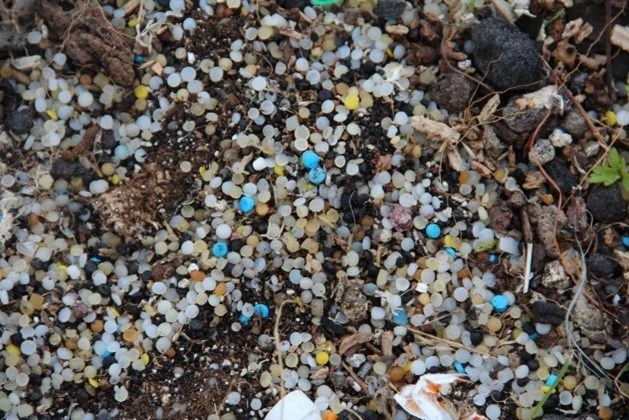
And they escape. Everywhere. All the time.
Not because of some exceptional glitch: no.
During transport, storage, processing, nurdles escape. Like a chronic, systemic leak.
And the sea picks up the tab.
Result: 230,000 tonnes of nurdles spilled into the global environment every year according to BurlingtonGreen.
Not a one-off leak, no: a continuous, structural flow.
These pellets pollute the oceans, infiltrate beaches, choke marine life. They concentrate toxins up to a million times more than the surrounding water.
Every plastic stopper, however bio it may be, is potentially born from a production chain that spreads its micro-waste before even finishing the product.
Cork knows no such ignominy.
No pellets, no parasitic industrial residue. Just bark, harvested by hand, and which returns to the soil if left unused.
Every nurdle that falls off a truck, every pellet that rolls out of a warehouse, is a promise of lasting contamination.
Cork, on the other hand, knows no such disgrace. It grows, it’s stripped, and no sea receives its toxic counterpart.
3. Biodiversity: living, complex forest versus suffocating monoculture.
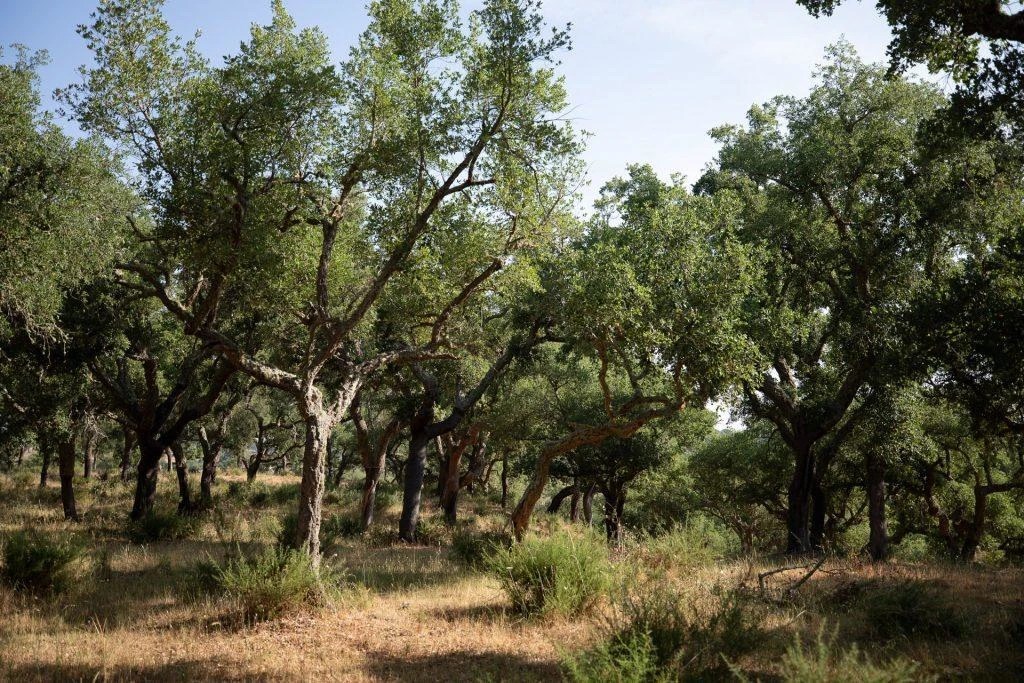
A suberosa, this forest dominated by cork oak, is not just a production zone: it’s a living sanctuary.
Each hectare hosts hundreds of species of birds, insects, mammals, and endemic flora. The soil is stable, drought is slowed, and fires struggle to spread thanks to the natural structure of the plant cover.
🌿 Biodiversity in suberosa forests: concrete and recent examples
Cork oak forests (suberosa), especially in the southwest of the Iberian Peninsula, are true reservoirs of life:
- Flagship birds:
- The Iberian imperial eagle (Aquila adalberti) and the black stork (Ciconia nigra) nest here, taking advantage of the dense cover and a low-disturbance environment.
- Rare mammals:
- The Iberian lynx (Lynx pardinus), one of the most endangered felines in the world, finds shelter and food in these forests.
- Specific insects:
- The stag beetle (Lucanus cervus), Europe’s largest beetle, depends on the dead wood found in these forests.
- The scarab Thorectes lusitanicus, which transports and buries acorns, even helps with the natural regeneration of oak.
- Micro-fauna and flora:
- These habitats shelter species such as the protected slug Geomalacus maculosus (slug of Ireland/Portugal), as well as woodland orchids, ferns and strawberry trees, reflecting a notable ecological complexity.
- Rich plant structure:
- Suberosa forests combine several layers (oaks, shrubs, herbaceous plants, vines), creating a robust ecosystem that naturally fights erosion, drought and slows the spread of fires.


In contrast, sugarcane is the archetype of industrial monoculture. A biological desert planted in tight rows, treated with herbicides, where only cane survives… until harvest.
Each hectare of sugarcane is a negation of diversity, a land emptied of its natural alternatives, a field looping endlessly to feed an industry, not an ecosystem.
Cork is life organizing itself. Sugarcane is life simplified to the point of suffocation.
But let’s go further… because there’s always room to push the reflection further.
Some farmers practice pre-harvest burning of sugarcane, but what’s the point?
It’s simple, it serves only one purpose: to make mechanical or manual harvesting easier.
Sugarcane grows surrounded by dry leaves, fibrous residues, and often infested with snakes or insects.
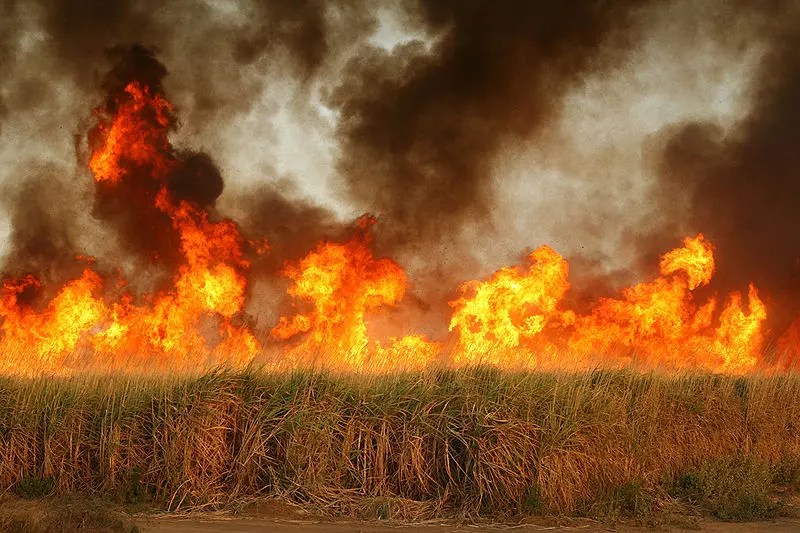
Burning before harvest allows:
- Eliminate dry leaves and plant waste, keeping only the sugar-filled stalk.
- Make access safer for cutters.
- Increase the efficiency of harvesting machines, which struggle to handle cane still wrapped in its vegetal sheath.
But this industrial shortcut comes with an ecological cost:
- Massive release of CO₂, methane, and fine particles.
- Depletion of the soil, as ash replaces the organic matter that should have decomposed naturally.
- Local air pollution, causing respiratory illness in cultivation areas.
Burning is a lazy compromise to save time and money, at the cost of an immediate carbon and toxic footprint.
Conclusion:
Ground fauna is burned alive: insects, small mammals, reptiles, none stand a chance against fast, violent fire.
Surface biodiversity eradicated: everything that crawls, flies low, or hides under leaves goes up in smoke.
Soil temporarily sterilised, worsening erosion and reducing natural fertility.
So yes, it wipes out the fauna before the cane is even cut.
A vegetal and animal genocide dressed up as agricultural practice.
But we live in a world where we’re supposed to look the other way, so let’s look the other way… and move on.
4. Durability: cork recycles or biodegrades, plastic stagnates.
The cork stopper, once its mission is complete, follows two paths:
- It recycles easily into insulation panels, coverings or design objects.
- It returns to the soil, where it biodegrades naturally, rejoining the organic matter cycle, leaving no toxic legacy.
The bio-based plastic stopper claims to be recyclable. But in reality?
Recyclable in theory, rarely recycled in practice. It ends up in landfills or in nature, where it breaks down into persistent microplastics, far outlasting the lifespan of the bottle it once sealed.
Cork dies as compost, plastic persists as waste.
Where some will reply that bio-based is recyclable, compostable or improvable… We have already dismantled those illusions in this article:
5. Socio-economy: local artisans versus offshored machines.
Each cork stopper is a living and rooted human chain:
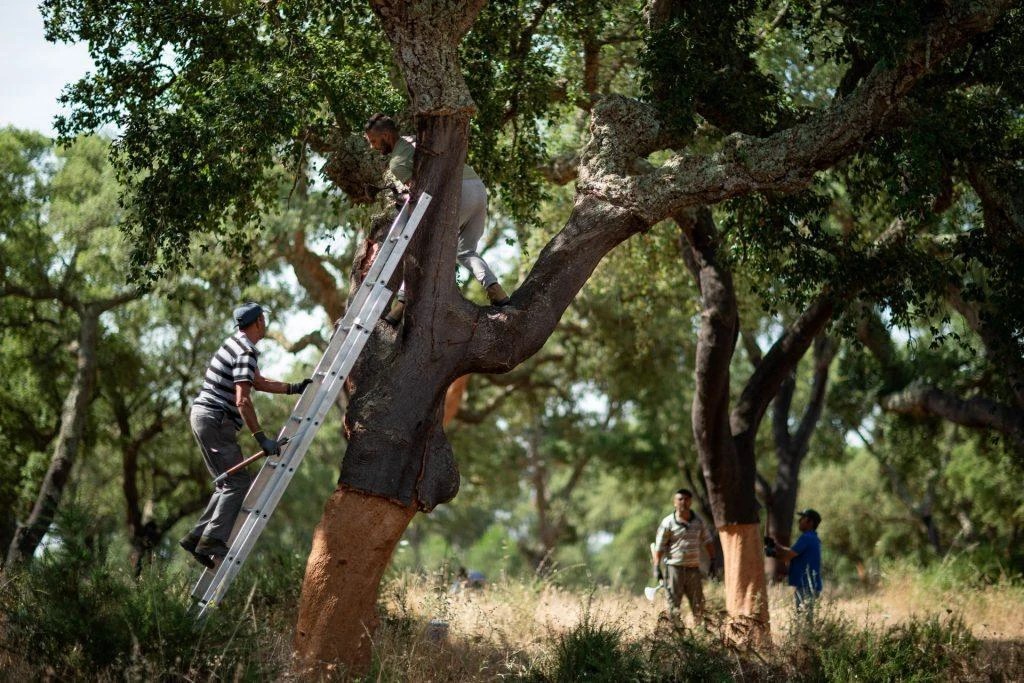
- Bark strippers, artisans trained sometimes over several generations, who harvest the bark by hand without harming the tree.
- Local workshops, in Portugal, Spain, the Mediterranean, where cork is processed, enhanced, sold.
- Every nine-year cycle activates a rural economy, passes down skills, and keeps wealth rooted in its land and its people.
Bio-based plastic, on the other hand, is a soulless machine:
Extrusion workers, often hastily trained, driving long distances each day to reach workshops where the air is saturated with IPA vapors (Isopropyl Alcohol), plastic particles, sometimes poorly ventilated, poorly monitored.
Production rhythms imposed by industrial chains (extrusion runs 24/7), in a model where man is just a cog to be replaced as soon as he falters.
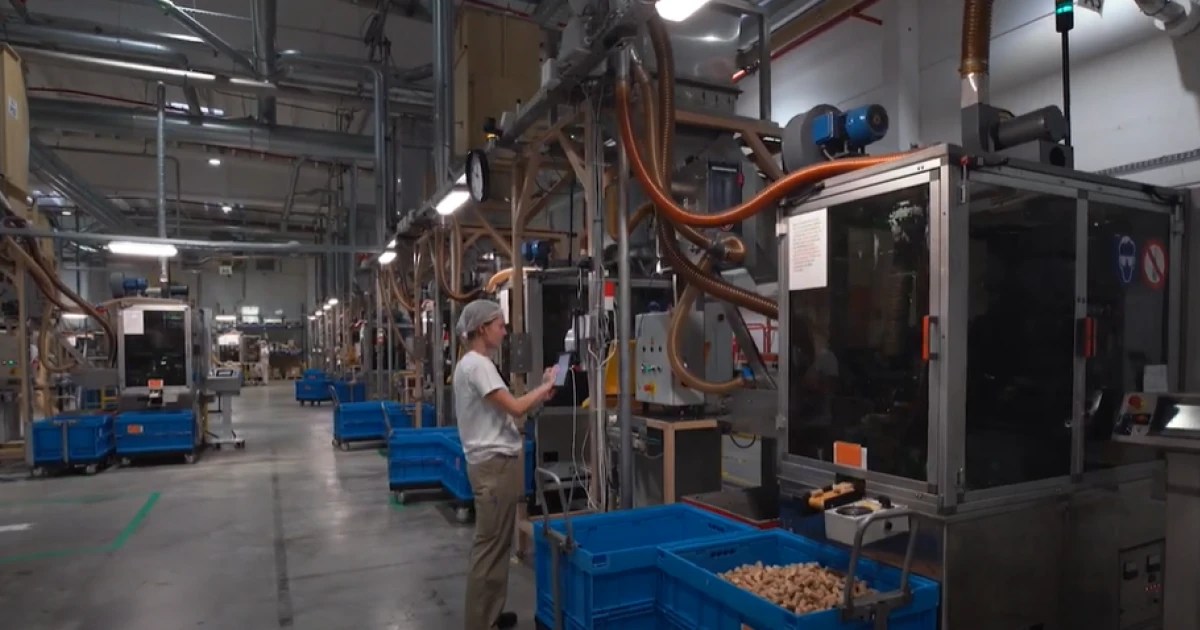
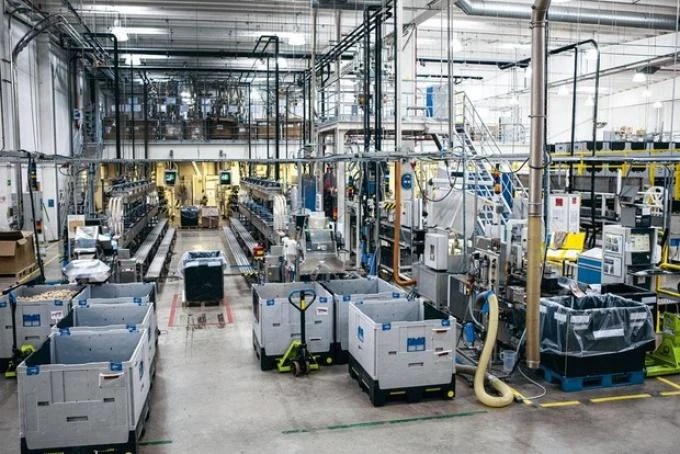
Yes, that’s a lot of machines… just for a stopper. And you still haven’t seen everything.
Where cork cultivates patience, skill, and transmission, plastic accelerates, exploits, discards.
On one side: territories that live.
On the other: people worn down to produce faster what nature would have offered better.
All in all, bio-based plastic is the antithesis:
an industrialised, mechanised, often offshored production, where the material travels thousands of kilometres before becoming a stopper. Few hands, many machines. Little territorial grounding, lots of global flows.
Where cork sustains rural life, plastic feeds anonymous production chains and the balance sheets of heavy industry.
6. Conclusion:
Bio-based plastic seals your bottles, nurdles clog the oceans.
Cork is not some recent discovery.
It’s a millennia-old solution, a material humanity has used for centuries, long before the word “sustainability” became a marketing slogan.
A noble material, functional, recyclable, biodegradable, and above all: deeply respectful of ecosystems.
But a few decades and a bunch of greed-stained hands were enough to replace that know-how with bio-based plastic… or not.
Why? Because plastic is cheaper to mass-produce, it allows for comfortable margins, it fits the industrial logic: produce fast, at low cost, and never mind the residue.
So this is modernity: replacing an ecological balance thousands of years old with a lab-born product that produces microplastics from the moment it’s made.
The result?
- A damaged artisanal sector.
- A damaged ecosystem.
- An ocean suffocating.
📌 Thrölian note for the nitpickers and compulsive wine lovers:
No, there will never be enough cork to seal all your bottles.
Cork oak has its biological limits: it takes 25 years for the first harvest, then a 9-year cycle, for a total of 150 to 200 years of service per tree. In short, it’s not Amazon Prime.
But let that be a lesson: cork can’t do everything, but plastic has never known how to do anything except pollute.
So before you wave the flag of industrial volume like a banner, remember there are two solutions as old as sobriety and intelligence:
- ✅ Reduce demand
No need to graduate from Centrale or give a TEDx talk:
Fewer bottles = fewer stoppers = less pollution.
- In France, that’s 4.2 billion bottles of wine per year. That means stoppers, cartons, glass, CO₂… and a few cases of cirrhosis.
- Drinking less means less pollution, but also fewer emergency trips to the hospital.
And for the die-hard fermented grape lovers, reusable containers have existed for centuries: amphorae, demijohns, bag-in-box… it’s not fancy, but the planet doesn’t care.
- ✅ Choose other materials
- Glass: heavy but almost infinitely recyclable.
- Aluminium: light, also recyclable, and far less deceitful than plastic dressed in green.
- Mechanical closures: a timeless classic that doesn’t leave nurdles in the ocean.
Is it perfect? No.
Is it better than bio-based plastic and its turtle-killing pellets? Yes, no discussion needed.
Cork isn’t enough. But plastic should never have existed in this debate.
It’s not here to meet a need, it’s here to let industry produce faster, further, dirtier, under the guise of green innovation.
So next time someone throws the “but we can’t seal everything with cork” argument at you, just remind them of this:
We can also drink less, drink better, and above all: pollute less stupidly.
Cork isn’t enough, fine. But plastic has never been an answer:
it’s just the alibi of those who want to produce more, faster, and pollute… quietly.
Thröl Haartkor Mk IV – Cork has limits. Your stupidity doesn’t. Make a choice.
Reading for the curious:
1. https://www.sciencedirect.com/science/article/abs/pii/S0959652622036629
2. https://amorimcorksolutions.com/en-us/why-cork/negative-carbon-balance/
3. https://www.5gyres.org/newsroom/plastic-pellets
4. https://www.earthisland.org/journal/index.php/articles/entry/nurdles-the-worst-toxic-waste-youve-probably-never-heard-of
5.https://www.fairtrade.net/content/dam/fairtrade/global/products/sugar/Fairtrade_Climate_Action_sugarcane_factsheet_2023_eb1c80a0d8.pdf
6. https://fr.wikipedia.org/wiki/Ch%C3%AAne-li%C3%A8ge
7. https://wwf.panda.org/wwf_news/?uLangID=3&uNewsID=22370
8. https://dspace.uevora.pt/rdpc/bitstream/10174/32335/1/CorkOakVegetationSeriesofSouthwestern.pdf
9. https://www.suberup.com/blog/biodiversite-suberaies-chene-liege
10. https://wwf.panda.org/?4802%252F3%252FChoisissez-les-bouchons-en-liege
11. https://ma.chm-cbd.net/fr/ecosystems/suberaies
12. https://www.cheneliege.fr/la-suberaie-un-milieu-riche-et-complexe/
13. https://corse.cnpf.fr/sites/corse/files/2022-01/guide_chene_liege.pdf
14. https://occitanie.cnpf.fr/sites/socle/files/cnpf-old/suberaies_1.pdf
15. https://www.dendrochronologie.ch/blog/les-peuplements-forestiers/le-chene-liege.html
16. https://fransylva-paca.fr/wp/le-chene-liege-et-les-suberaies/
17. https://www.doc-developpement-durable.org/file/Culture/Arbres-Fruitiers/FICHES_ARBRES/Amandier/amandier.pdf
18. https://www.burlingtongreen.org/fr/nouvelles/quest-ce-que-les-nurdles-2/
Laisser un commentaire