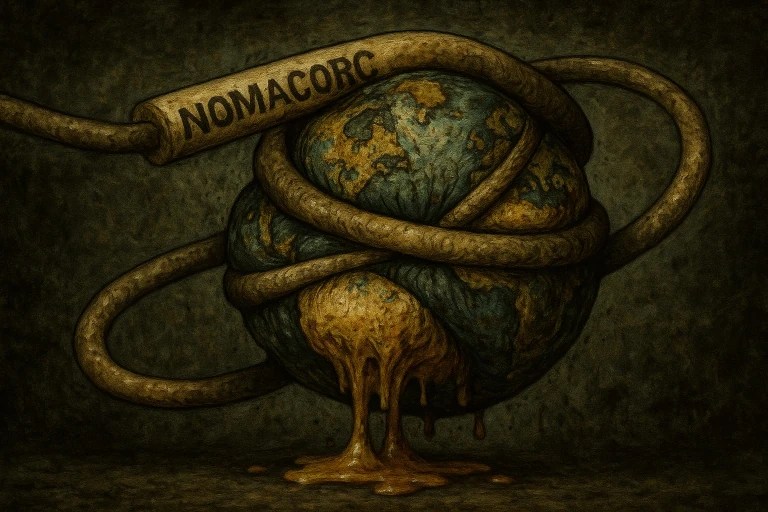
Ecology, that pretty story we tell ourselves
📜 Editorial Disclaimer
This text is an exercise in free critique, protected under the fundamental right to freedom of expression (Article 19 of the Universal Declaration of Human Rights, Article 10 of the European Convention on Human Rights, and applicable Belgian law). It draws exclusively on public sources, accessible to anyone who knows how to type a URL.
This is not a scoop, nor a manifesto. It is an editorial analysis. And like any good dissection, it doesn’t judge the intentions of the body laid out on the table, it examines its structures, its silences, its contradictions.
In this case, the body is called Vinventions, market leader in plastic wine closures. If that name appears, it’s not out of provocation or obsession, but because being number one also means becoming the default narrative. Which makes it a subject of study as legitimate as it is necessary.
This text constitutes a critical analysis of public information and should not be interpreted as an exhaustive evaluation or a value judgment on all activities or legal entities mentioned.
This is not an attack. This is not fiction. This is not a trial.
It’s a scalpel resting on a story so polished it slips past critical thought.
Today, plastic isn’t discarded anymore – it incarnates.
The stopper becomes a symbol, marketing turns liturgical, and carbon neutrality parades like grace from the regulatory heavens.
Vinventions? Not just an actor. It’s the studio, the teleprompter, and the voiceover.
The narrative is polished, the tone soothing, and the intent – admirable.
Or so we’re meant to believe.
♻️ Green Line : recyclable… But never recycled.

Ah, the Green Line. Sounds like a hydrogen train route, doesn’t it? But no – it’s just plastic. Recyclable, they say. Biobased, they claim. Benevolent, they murmur like priests. In short – a product engineered to stroke your conscience before your palate.
But let’s dwell on that magic word: recyclable. It rings clean, modern, virtuous. Except recyclable isn’t recycled. Not by a long shot. The OECD spelled it out, plain as day, in its Global Plastics Outlook: barely 9% of the world’s plastics actually got recycled in 2023. The other 91%? Straight to the incinerator, the landfill, or the wild ocean.
And that’s assuming it could be recycled at all. According to PlasticsEurope, small plastic items – stoper at the top of the list – are sorting-line phantoms – too light, too small, too elusive. Citeo confirms it: isolated caps are kicked out of standard circuits. They never make it past the factory gate. Recyclable in theory – not in reality.
Even biobased materials can’t save the day. Biobased PE, says ADEME, is technically recyclable. But in practice? Zero compatibility with existing streams. Translation: slap a green label on an object doomed for grey – or for fire.
So, the Green Line? A masterclass in marketing. Circular storytelling for a linear object. A cap dreaming of industrial utopia, but usually ending up in a ditch. Better named, better sold, not better treated.
The real question isn’t: “Is it recyclable?”
It’s: “Who actually recycles? And at what cost?”
https://throlhaartkor.com/2025/06/14/the-truth-about-bioplastics-illusion-or-reality
🌊 Nomacorc Ocean: “Recycled” – a magician’s favorite word.

There’s a salty whiff of plastic redemption in the air. The “Nomacorc Ocean” cap is paraded as the green messiah – rescued from the waves, regenerated by human hands, parading as the revenge of waste. Except here, while the story floats, reality… hits the seabed.
According to the OBP Certification Guidelines from Zero Plastic Oceans, for a plastic to really earn the “ocean-bound” badge, it has to come from coastal zones vulnerable to marine pollution, within a 50 km range. But here’s the twist: there’s no public data clarifying what exact share of these caps actually comes from those zones, or from the water itself. No clue when the sorting happens, or under what conditions.
And those vaunted labels? Plastic Bank, Oceanworks – you’ll find them front and center in the marketing spiel. But in practice, their traceability statements have one thing in common: a glaring lack of published independent audits, and a conspicuous silence around the full supply chain.(which we dissect point by point in the article at the bottom of the page).
The UNEP report is a cold reminder: plastics “collected from coasts” are just a drop in the ocean of marine waste. The vast majority is already sunk to the bottom. Coastal cleanups, however well-intentioned, barely scratch the surface logistically or ecologically.
And according to the Ellen MacArthur Foundation, the term “ocean-bound” itself has become a marketing trinket: flashy, rarely evidenced, purely cosmetic – with zero real systemic change.
So let’s ask the real questions:
- How much ocean plastic, actually?
- Who checks it?
- What’s the energy cost of the process?
But after all, why bother with numbers when the sea is so inspiring and the story so well wrapped?
https://throlhaartkor.com/2025/06/17/ocean-recycled-wine-closures-promises-vs-reality
🧪 SÜBR: the stoper that ticks every box… even the ones nobody knew existed.

Sometimes a product steps onto the stage with so much aura you’re no longer sure if it’s an object or an ideology made flesh. SÜBR is that moment. Zero glue. Zero plastic. Zero questions – or so it hopes. It poses as a stoper, performs as a revolution. The zen of agglomerated cork.
Except even minimalism needs structure.
The European Cork Confederation (CE Liège) doesn’t mince words: every agglomerated cork requires a binder, whether it’s polyurethane-based, resin-based, or otherwise. And to date, not a single binder-free industrial method has been validated or published, according to the literature on so-called “PU-free” tech. The dream of a self-binding cork? Still just a dream.
And transparency? Cork Supply / Vinventions, who trumpet the product, offer zero public technical detail. No precise composition, no accessible patent, no verifiable test protocol.
As for durability – that magic word, so often summoned, so rarely measured – no sign of any open data tests. The product claims “eco-responsibility,” but the proof stays neatly offstage.
Yes, SÜBR makes an impression. It looks like it was cut straight from the responsible design handbook. But without data, without details, without independent checks, it’s no longer innovation – it’s branded belief, vacuum-packed. An object of dense, compact, almost poetic storytelling.
And like every piece of industrial poetry, it deserves to be read aloud. And every word deserves to be questioned.
⚖️ Carbon neutrality: an idea too perfect to be disturbed

At Vinventions, carbon neutrality isn’t just a target – it’s a mood.
A gentle, all-encompassing promise, proudly splashed across their Green Line materials.
The stated footprint? -0.4 to -1.3 grams of CO₂ equivalent per cap.
A miracle of engineering – if you’re okay with blind faith.
But as with most miracles, the instruction manual is nowhere to be found.
Their 2022–2023 carbon footprint report includes zero methodological details.
No emission factors. No scope. No lifecycle in sight.
Just the number. Bare. Absolute. Perfectly indisputable, because perfectly unverifiable.
They invoke ISO 14067:2018, the standard for product carbon footprints.
But there’s no certificate. No independent audit. The standard is invoked like a ritual, not applied like a tool.
ADEME’s “Neutralité carbone: mirage ou méthode?” makes it clear:
No neutrality without a quantified reduction plan, a measurable path, and full transparency.
Here? All missing. Except the word “neutral.”
And in official sources like Carbon Trust or CDP? Vinventions is absent.
No certification. No third-party review. Just branding suspended in pure narrative.
So let’s call a cap a cap: this isn’t climate performance.
It’s a virtue story. Emotional value, factory-sealed – where absence of proof becomes proof of untouchable purity.
Faith is beautiful. But when it claims to be carbon-neutral, it should leave a few numbers behind.
https://throlhaartkor.com/2025/06/15/the-untold-lifecycle-of-plastic-caps
📷 Everything’s perfect. Too perfect?

At a glance, you can feel the control: communication rolling out like synthetic moss. Soothing green, deep blue, minimalist fonts, regenerative slogans. A world packaged like an ESG deck after six LinkedIn filters.
But with all this visual perfection, a doubt creeps in: what if the essentials are somewhere else? What if this perfectly oiled set isn’t the echo of transformation, but the illusion of its completion?
The Green Claims Directive proposed by the European Commission sets the tone: every environmental claim will soon have to be verified, documented, accessible. In other words, the era of freewheeling slogans is on borrowed time.
ADEME, in its Environmental Claims Evaluation Guide, echoes this: you can’t claim without proof. Every impact statement must come with concrete, legible, publicly available data.
But for now, we’re usually left with the visual effect. According to Futerra, companies feast on green aesthetics — natural tones, organic fonts, leaf icons – to imply commitment where there is none. – natural colors, organic fonts, leaf icons – to suggest commitment where there is little or none.
And Harvard Business Review puts it bluntly: this “eco-performative” comms strategy delivers little real value, but a great deal of narrative comfort. It lets you claim the field… without ever cleaning it.
In short, Vinventions doesn’t just sell caps. It sells a story: clean, framed, highly scripted.
A world where every color says: “Move along, nothing left to fix here.”
But asking the right questions already stains the image a little. And sometimes, that’s necessary.
🔍 Transparency: a choice, not a duty
Let’s be fair: no one’s forcing a company to spill every secret. But when all you do is hint, never prove, you start to wonder if silence is strategy or just negligence.
Maybe that’s the real paradox: the prettier the promise, the more suspect it becomes.
🧷 Conclusion: the illusion of impact
Vinventions seems to usher in a new age of eco-responsibility – one where discourse is gospel, and coherence is measured in pixels and palette.
But if sustainability turns into a marketing object, then maybe the stoper really is the perfect symbol: solid, smooth, neutral. And utterly impervious to contradiction.
Thröl Haartkor Mk III – Ironic, methodical, and ruthless with stories scrubbed too clean.
https://throlhaartkor.com/2025/06/16/decryptage-du-rapport-rse-de-vinventions
📚 SOURCES:
♻️ Green Line: Recyclability in principle vs. on-the-ground reality
- OECD (2023) – Global Plastics Outlook: Policy Scenarios to 2060
→ Just 9% of plastics worldwide were actually recycled in 2023. - PlasticsEurope (2023) – Plastics – the Facts
→ sorting limitations for small plastic items, including caps - ADEME (2021) – Bioplastiques : définitions, usages, perspectives
→ Biobased PE is technically recyclable, but not in practice. - Citeo (2022) – Tri des petits plastiques : défis industriels
→ Isolated caps are excluded from standard recycling streams.
🌊 Nomacorc Ocean: transparency at low tide
- Zero Plastic Oceans – OBP Certification Guidelines
→ Mandatory reference to so-called “ocean plastics.” - Plastic Bank / Oceanworks – Traceability Statements & Partner Materials
→ Present in the branding, absent from independent evaluation. - UNEP (2021) – From Pollution to Solution: A Global Assessment of Marine Litter and Plastic Pollution
→ Reference framework for actual coastal recovery rates. - Ellen MacArthur Foundation (2023) – Global Commitment Report
→Warning: the “ocean-bound” claim is mostly cosmetic.
🧪 SÜBR : innovation ou tour de passe-passe ?
- A product sheet from APCOR (Associação Portuguesa da Cortiça) makes it clear:
- Technical (agglomerated) corks are made from cork granules bound with specific adhesives, such as polyurethanes.
- Cork Supply / Vinventions (official site) – No public technical details.
- Technical reports not referenced – No durability testing in open data.
⚖️ Carbon neutrality: faith without a cathedral
- Vinventions (2022-2023) – Green Line Carbon Footprint Claim
→ Claims a “negative footprint” (–0.4 to –1.3 g CO₂eq), without showing the math. - ISO 14067:2018 – Greenhouse gases — Carbon footprint of products
→ Standard invoked, but no certificate or published audit. - ADEME (2022) – Neutralité carbone : mirage ou méthode ?
→Reminds us it’s impossible to claim neutrality without a complete, detailed plan. - Carbon Trust / CDP – Product Certification Library
→ Vinventions : Absent from certified databases.
📷 ESG aesthetics vs. environmental substance
- European Commission (2023) – Green Claims Directive (proposition)
→ A future framework against unverified claims. - ADEME (2023) – Guide d’évaluation des allégations environnementales
→ Any mention of impact must be backed by accessible data. - Harvard Business Review (2022) – How Greenwashing Affects the Bottom Line
→ Decoding the usual cracks in companies’ “eco-performative” mode.
Thröl Haartkor Mk III – Information’s like a plastic closure: it floats or it sinks. Me, I drag it out of the water.